
For countless writers, the moment of reckoning with a messy draft is a universal experience. The instinctive modern solution has been to turn to artificial intelligence, carefully engineering prompts for “feedback,” “rewrites,” or “tone adjustments.” However, a quietly revolutionary and counterintuitive method is gaining traction among professional editors and authors, fundamentally altering the collaborative dynamic between human and machine. This technique, known as the “zero-prompt” or “cold upload” method, involves submitting a document to an AI chatbot without a single word of instruction. By deliberately withholding direction, writers bypass the limitations of engineered requests and unlock a form of raw, comprehensive, and surprisingly expert-level editorial analysis that often surpasses the quality of prompted responses, transforming the AI from a directed assistant into an autonomous first reader.
Deconstructing the Method: The Psychology of the Blank Slate
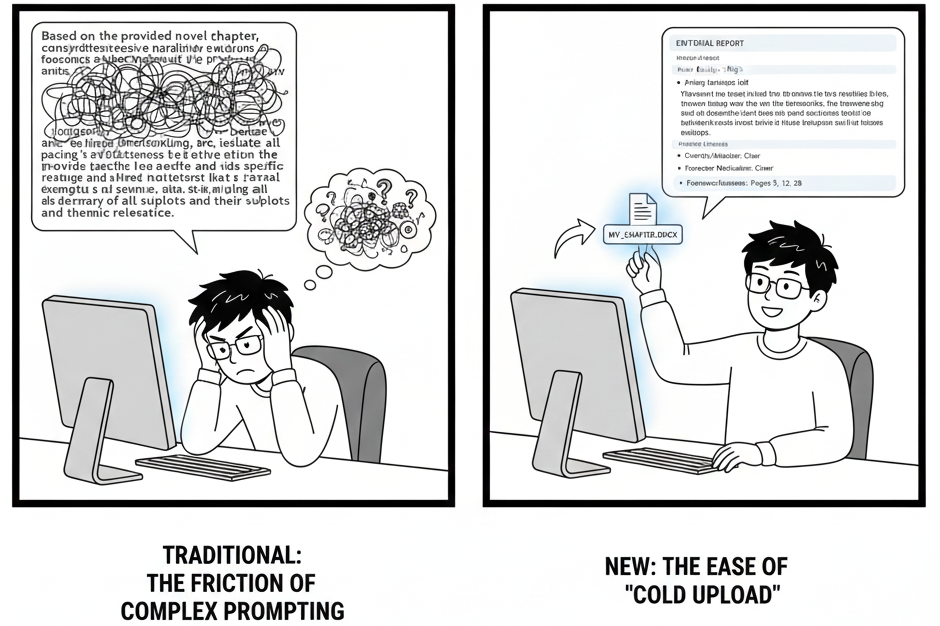
The process is disarmingly simple in execution but profound in its cognitive implications. Instead of crafting a detailed query, the writer accesses the chat interface of a platform like ChatGPT, Claude, or Gemini, uploads their document file (a .docx, .txt, or .pdf), and submits it immediately. The critical act is the absence of a typed prompt in the message box.
Faced with only the raw text, the large language model (LLM) cannot rely on user instructions to narrow its task. Consequently, it must analyze the content itself to infer purpose and context. This triggers a default, comprehensive analytical mode. The AI systematically evaluates the writing across multiple dimensions: narrative structure and logical flow, pacing and rhythm, tonal consistency, clarity of argument, character development (in fiction), and grammatical coherence. In essence, the document itself becomes the ultimate context-rich prompt, forcing the AI to engage with the work on its own terms and report back on what it perceives as the most salient features both strengths and weaknesses.
The Unvarnished Advantage: Honest Critique and Hidden Flaws
This unprompted approach delivers several tangible benefits that address core frustrations in the writing process.
- Unfiltered, Honest Criticism: When you ask an AI to “provide kind feedback” or “suggest gentle improvements,” you program its tone. Without any steering, the model provides blunt, observational feedback. It highlights areas of confusion, narrative dead ends, repetitive phrasing, and weak arguments without the softening filter of a “constructive” directive. This raw feedback is often more valuable for serious revision than padded encouragement.
- Surfacing Blind Spots: Writers are inherently close to their work. This proximity can blind them to plot holes, inconsistent character motivations, or logical fallacies in an argument. The AI, having no prior knowledge, acts as a fresh set of eyes. It will frequently flag issues the author is too immersed to see, such as a supporting character who vanishes for three chapters or a key piece of evidence introduced too late in an essay.
- Efficiency and Breakthroughs: The method saves considerable time otherwise spent iterating on prompt design. More importantly, it can lead to creative breakthroughs. By revealing how an intelligent but uninformed reader interprets the text, it can open entirely new avenues for restructuring or clarifying the core message that the writer, trapped in their original intent, had not considered.
Strategic Application: From Brainstorming to Final Polish
The versatility of the zero-prompt method makes it applicable across the entire creative lifecycle.
- Early-Stage Brainstorming: Upload a page of disjointed notes or a rough concept. The AI will often synthesize the ideas, identify potential themes, and suggest a possible structure or outline, providing a creative jumpstart.
- Developmental Editing: For a complete draft of a chapter or article, the cold upload yields high-level feedback on structure, argument flow, and overall impact the domain of a developmental editor.
- Sensitivity and Perspective Checking: The AI can inadvertently highlight unconscious bias or areas where the writing assumes too much prior knowledge from a general audience, offering a crude but useful perspective check.
- Multi-Model Panels: For crucial work, upload the same document to ChatGPT, Claude, and Gemini sequentially. Each model has different analytical strengths and biases, and their collective, unsteered feedback creates a powerful “editorial panel” effect, offering a well-rounded view.
Navigating the Limitations and Integrating Feedback
It is crucial to recognize this as a tool, not an oracle. The AI lacks true understanding and creative intent. Its feedback should be engaged with critically.
- The “Why” is Missing: The AI can identify what is not working (e.g., “this paragraph is confusing”) but often cannot articulate a deeply creative why or propose a nuanced solution that aligns with your unique voice. That creative synthesis remains your job.
- Factual and Hallucination Risks: It may misinterpret factual content in non-fiction or “hallucinate” details not present in the text. Always verify its observations against your manuscript.
- The Curator’s Role: The writer must become a skilled curator of the AI’s output. The goal is not to implement every suggestion, but to identify the recurring, resonant criticisms that align with your own gut feelings about the draft’s weak points.
The Evolving Partnership: Redefining the Writer’s Workflow
Adopting the zero-prompt method necessitates a shift in mindset. The AI is no longer a clerk to be commanded but a reactive mirror held up to your work. It excels at description, not prescription. By consistently applying this technique at various draft stages from the messy first attempt to the near-final polish writers cultivate a discipline of external review. This practice builds continuous, unbiased clarity regarding a manuscript’s evolving strengths and weaknesses. Ultimately, the silent upload does not replace the writer’s judgment; it sharpens it. It transforms the solitary act of writing into a dynamic dialogue, using artificial intelligence not to generate content, but to relentlessly question and refine the content only a human can create.
Explore Steaktek for more updates.

