

Las Vegas during a Formula 1 Grand Prix weekend transforms into a breathtaking crucible for photography: a volatile mix of searing neon, cavernous darkness, unpredictable weather, and fleeting moments of high-octane spectacle. For mobile photographers, this environment presents the ultimate real-world test, pushing computational photography and optical hardware to their absolute limits. To determine which flagship camera phone currently delivers the most compelling visual narrative, I conducted a rigorous, side-by-side field test of the three titans: the Samsung Galaxy S25 Ultra, the Google Pixel 10 Pro XL, and the Apple iPhone 17 Pro. While original plans for capturing the race itself were altered due to access restrictions, the resulting comparison across the city’s punishing extremes dimly lit showrooms, chaotic concerts, and neon-drenched streets reveals a nuanced portrait of their distinct photographic philosophies and, ultimately, which device handles chaos with the most creative grace.
Stage One: The Indoor Gauntlet – Showcars, Reflections, and Mixed Light
The first challenge unfolded indoors, photographing static but visually complex Formula 1 showcars under the difficult lighting of Las Vegas hotel lobbies. These scenarios tested each phone’s ability to manage color science, dynamic range, and white balance in suboptimal conditions.
- The Cosmopolitan’s Haas Display: Here, a vibrant red Haas VF-24 sat against a dark, moody backdrop. All three phones captured the scene, but their interpretations diverged significantly. The iPhone 17 Pro rendered the car with aggressive saturation and a notably warm color cast, creating a punchy but somewhat exaggerated image. The Pixel 10 Pro XL delivered what was arguably the most accurate and balanced color, maintaining the car’s true red while preserving detail in the shadows. The Galaxy S25 Ultra produced a clean, bright image, but its processing leaned slightly cooler, giving the red a more crimson hue.
- The Mercedes Showcase: This presented a tougher test with harsh mixed lighting dim interior illumination against bright exterior windows. In this scenario, the iPhone 17 Pro excelled, striking an impressive balance between the darkened interior details of the car and the view outside the windows. Both the Pixel and Galaxy models, in their pursuit of exposing for the bright exterior, allowed the foreground details of the Mercedes to fall into deeper shadow, showcasing the iPhone’s superior HDR fusion in this specific high-contrast environment.
Stage Two: The Nocturnal Crucible – Concerts and Neon
Las Vegas truly comes alive at night, and the cameras were thrown into two extremes: the controlled chaos of a concert and the iconic glow of its neon landmarks.
- T-Pain at The Cosmopolitan: This was arguably the most technically demanding test. Shooting from the crowd in near-total darkness, with only rapidly strobing, multi-colored stage lights illuminating a moving performer, pushed all systems to their limit. Using telephoto lenses to isolate the artist, all three predictably struggled with motion blur and intermittent focus hunting. Yet, amidst the challenge, the Google Pixel 10 Pro XL produced the most compelling and usable image. Google’s computational photography stack, honed for night sight and astrophotography, managed to pull a surprising amount of clean detail from T-Pain’s face and costume, with less digital noise and more natural color in the sporadic light than its competitors a testament to its software supremacy in extreme low-light.
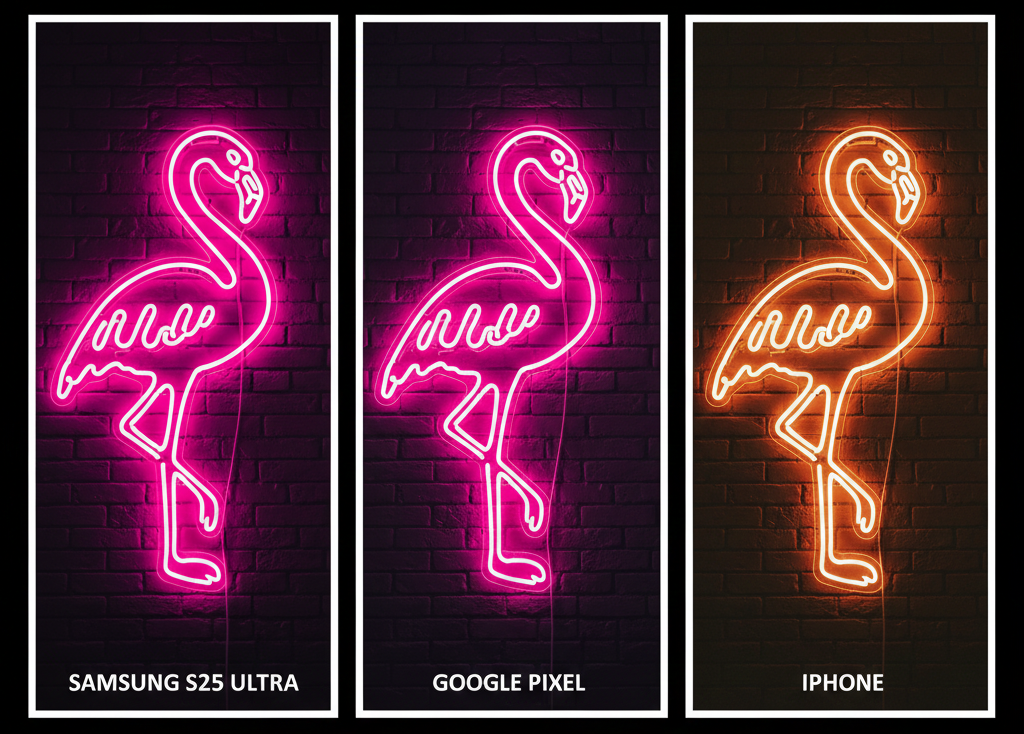
- Neon at The Flamingo: Capturing the iconic Flamingo neon sign tested color vibrancy, highlight control, and text clarity against a night sky. Here, the Samsung Galaxy S25 Ultra demonstrated a particular mastery. It captured the neon’s brilliant pink and orange hues with stunning vibrance and richness while maintaining perfect clarity in the “Flamingo” lettering. Its image had a “pop” that felt most authentic to the Vegas neon experience. The iPhone again leaned warm, giving the sign a slightly orange tint, while the Pixel produced a more muted, albeit very accurate, representation.
Stage Three: Architectural and Atmospheric Storytelling
Beyond the spectacle, capturing the city’s diverse environments revealed each phone’s character in more nuanced compositions.
- F1 Arcade & The Ski Lodge: Shooting the classical columns of the F1 Arcade tested detail rendering and exposure in grand spaces, while the Heavy Metal Holiday-themed bar offered a test of atmosphere and mood. The iPhone 17 Pro consistently produced the warmest, most saturated images. This worked brilliantly for the atmospheric, dimly-lit bar, enhancing the cozy, vintage feel. However, it sometimes hindered the architectural shots, where a more neutral palette was preferable for accuracy. The Pixel 10 Pro XL excelled at capturing sharp, detailed textures in the columns but occasionally produced slightly softer focus in the bar’s low-light interior. The Galaxy S25 Ultra proved to be the most versatile chameleon, delivering excellent results in both scenarios, though a tendency to sometimes prioritize the brightest part of a scene (like a background light) over the main subject hinted at an autofocus system tuned for brightness.
The Final Analysis: A Philosophy of Image-Making
This grueling Las Vegas test reveals that there is no single “best” camera, but rather three distinct tools tailored to different photographic instincts.
| Samsung Galaxy S25 Ultra | Google Pixel 10 Pro XL | Apple iPhone 17 Pro |
|---|---|---|
| The Vibrancy Virtuoso: Excels in capturing vivid, eye-catching color and detail, particularly with reflective or emissive light like neon. A versatile powerhouse for the confident editor. | The Computational Master: Dominates in the most challenging low-light conditions and delivers the most consistently accurate white balance and color science straight out of the camera. | The Atmospheric Storyteller: Prioritizes a pleasing, warm, and contrast-rich aesthetic that often creates the most immediately “beautiful” and social media-ready images, with superb HDR handling. |
| Best for: Photographers who love bold, vibrant colors and don’t mind a cooler or more processed look; excellent all-around versatility. | Best for: Purists and low-light warriors who want the most accurate or computationally salvaged shot in impossible conditions. | Best for: Those who value a consistent, polished, and aesthetically pleasing image with minimal editing, especially in mixed-light environments. |
The Verdict from the Neon Glow
After a weekend battling Las Vegas’s extremes, the winner depends on your personal photographic creed. If you demand technical mastery in the dark and color accuracy, the Google Pixel 10 Pro XL stands as the computational champion. If you crave vibrant, share-ready images with stunning pop straight from the lens, the Apple iPhone 17 Pro delivers consistent beauty. And if you desire ultimate versatility and a bold, detail-rich rendering across a wild variety of scenes, the Samsung Galaxy S25 Ultra is your resilient companion. In the end, the chaotic heart of Las Vegas proved that mobile photography has matured beyond specs. It’s now a profound choice of visual language.
Explore Steaktek for more updates.

